
🧮 Get clear, step-by-step results using this calculator — it simplifies augmented matrices into reduced row echelon form for quick and reliable answers ✅📊
Coefficient of Determination Calculator (R²) – Calculate & Interpret R Squared
Use this coefficient of determination calculator to instantly calculate R squared (R² value) for any two-variable dataset. This free online R squared calculator helps you measure the goodness of fit of a regression model and understand how well your independent variable explains the dependent variable.
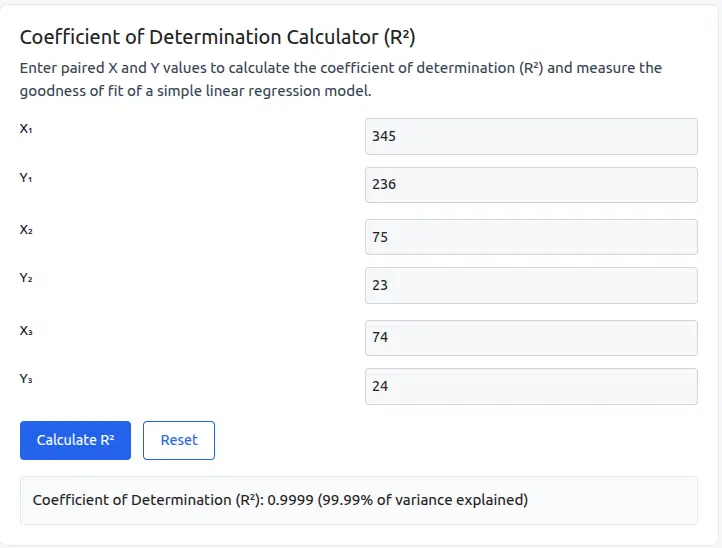
Coefficient of Determination Calculator (R²)
Enter paired X and Y values to calculate the coefficient of determination (R²) and measure the goodness of fit of a simple linear regression model.
Coefficient of Determination (R²): —
Whether you are a student, researcher, or analyst, this tool lets you calculate R squared in seconds while also providing a clear explanation of what the result actually means.
What Is the Coefficient of Determination?
The coefficient of determination, commonly written as R² (R squared), is a statistical measure used in linear regression analysis. It shows the proportion of variance in the dependent variable that can be explained by the independent variable.
In simple terms, R² tells you how well your regression model fits the real data. Because of this, it is often called the regression goodness of fit.
- R² ranges from 0 to 1
- Higher values mean better model performance
- Lower values indicate weak predictive power
What Does R Squared Mean?
The R squared value represents the percentage of the total variance in the explained variable that is accounted for by the regression model.
- R² = 1 → Perfect fit (all data points lie on the regression line)
- R² = 0 → The model predicts no better than the mean of Y
For example:
- R² = 0.80 → 80% of the variance in Y is explained by X
- R² = 0.50 → Only half of the variance in Y is explained
The remaining percentage, (1 − R²), represents the unexplained variance.
How to Use the Coefficient of Determination Calculator
This online R squared calculator is designed for simple linear regression. Follow these steps:
- Enter your x and y values into the data table
- Add at least three data points
- The calculator automatically computes the R² value
- View both a numerical result and a plain-English interpretation
This makes it easy to find the coefficient of determination without manual calculations.
Coefficient of Determination Formula (R²)
The coefficient of determination formula is based on three types of sums of squares used in regression analysis.
Key Components
- SSE – Sum of Squared Errors (residual sum of squares)
- SSR – Regression Sum of Squares (explained variance)
- SST – Total Sum of Squares (total variance)
These values follow the relationship:
SST = SSR + SSE
R Squared Formula
- R² = SSR / SST
- R² = 1 − (SSE / SST)
- R² = SSR / (SSR + SSE)
All formulas produce the same R² value.
How to Calculate R Squared by Hand (Step-by-Step)
Let’s walk through a manual R squared calculation using a simple dataset:
Data points: (0,1), (2,4), (4,4)
- Compute the mean of Y: ȳ = 3
- Fit the regression line: Y = 0.75X + 1.5
- Calculate predicted values (ŷ)
- Compute SST = 6
- Compute SSR = 4.5
- Apply the formula: R² = 4.5 / 6 = 0.75
This means 75% of the variance in Y is explained by X.
Explained vs Unexplained Variance
Understanding variance is key to interpreting R² correctly.
- Explained variance (SSR) – Variation captured by the model
- Unexplained variance (SSE) – Noise or error not explained
- Total variance (SST) – Overall variability in the data
A higher explained variance indicates stronger predictive accuracy.
R Squared and Correlation
In simple linear regression, the coefficient of determination is directly related to the Pearson correlation coefficient.
Specifically:
R² = r²
If the correlation coefficient is r = 0.9, then:
- r² = 0.81
- 81% of the variability in Y is explained by X
This relationship does not always hold for multiple regression models.
When a High R Squared Can Be Misleading
While a high R² often indicates good model performance, it does not guarantee:
- Causation
- Correct model specification
- Statistical significance
R² should always be interpreted alongside residual analysis and domain knowledge.
Why Use Our Free R Squared Calculator?
- Instant and accurate results
- No formulas required
- Clear interpretation for beginners
- Supports up to 30 data points
- Perfect for statistics and data analysis
Frequently Asked Questions About the Coefficient of Determination
How does a coefficient of determination calculator with steps work?
A coefficient of determination calculator with steps shows each stage of the R² calculation, including computing the mean, regression line, sums of squares (SST, SSR, SSE), and the final R squared value. This step-by-step output helps users understand how the coefficient of determination is derived, not just the final result.
What is a coefficient of determination calculator regression used for?
A coefficient of determination calculator regression is used to measure how well a regression model explains the relationship between an independent variable and a dependent variable. It quantifies the goodness of fit of a linear regression model using the R² value.
What does a coefficient of determination calculator r squared calculate?
A coefficient of determination calculator r squared calculates the R² value, which represents the proportion of variance in the dependent variable that is explained by the independent variable in a regression model.
How to calculate the coefficient of determination in Excel?
To learn how to calculate the coefficient of determination in Excel, you can use the RSQ function by selecting your known y-values and x-values. Excel will return the R² value directly, allowing you to assess model fit without manual calculations.
Where can I find coefficient of determination solved examples?
Coefficient of determination solved examples typically include a dataset, calculation of predicted values, sums of squares, and the final R² value. These examples help users understand how R squared is computed step by step using real numerical data.
How to calculate the coefficient of determination calculator given R?
To calculate the coefficient of determination calculator given R, simply square the correlation coefficient. If R is the Pearson correlation coefficient, then R² is obtained by multiplying R by itself.
How to calculate coefficient of determination from correlation coefficient?
If you want to know how to calculate coefficient of determination from correlation coefficient, take the value of the Pearson correlation coefficient and square it. The resulting value represents the proportion of variance explained by the model.
How to interpret coefficient of determination?
Understanding how to interpret coefficient of determination involves examining the R² value between 0 and 1. Higher values indicate stronger explanatory power of the regression model, while lower values suggest limited predictive accuracy.
Use this coefficient of determination calculator to better understand your data, improve regression models, and make informed statistical decisions.
✨ Lucky Car & Bike Number Tool – See if your vehicle number attracts success, safety, and positive energy.
🧾 Unicode to Non-Unicode Font Converter – Preserve text structure while converting Unicode content into legacy font styles.
✨ Facial Proportion Analyzer evaluates facial measurements using the golden ratio to assess symmetry and aesthetic balance.