
Interval of Convergence Calculator
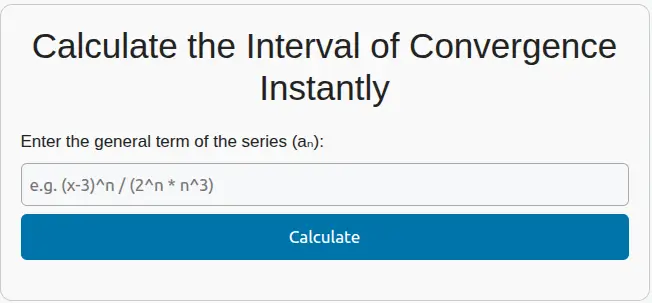
Calculate the Interval of Convergence Instantly
Use this Interval of Convergence Calculator to find the radius and interval of convergence for any power series in seconds.
Enter the general term of the series and get accurate results with step-by-step explanations using the ratio test, root test, and endpoint checks.
👉 No login. No downloads. 100% free.
Supported methods:
- Ratio Test
- Root Test
- Power Series Test
- Endpoint Convergence Check
⚡ Try Example Series (1-Click)
Use these common examples to instantly test convergence:
- (x − 1)ⁿ / n
- (x + 2)ⁿ / 3ⁿ
- (-1)ⁿ (x − 4)ⁿ / n
- (x²)ⁿ / 5ⁿ
📘 What Is the Interval of Convergence?
In calculus, the interval of convergence is the set of all x-values for which a power series converges to a finite value.
A power series is written as:
∑cn(x−a)n
Where:
- a = center of the series
- R = radius of convergence
Convergence Rules:
- If |x − a| < R, the series converges
- If |x − a| > R, the series diverges
- Endpoints x = a ± R must be tested separately
The final interval is written as:
(a−R,a+R)
🔍 How This Interval of Convergence Calculator Works
- Enter the general term of the power series
- Select the variable (usually x)
- Click Calculate
- The calculator:
- Applies the correct convergence test
- Finds the radius R
- Tests both endpoints
- Displays the final interval of convergence
🧠 Interval of Convergence vs Radius of Convergence
Concept | Meaning |
Radius of Convergence (R) | Distance from the center where convergence holds |
Interval of Convergence | Actual range of x-values where the series converges |
➡️ The radius is a number
➡️ The interval is a range
🧪 Common Methods to Find the Interval of Convergence
1️⃣ Ratio Test
L=n→∞limanan+1
- If L < 1 → Converges
- If L > 1 → Diverges
- If L = 1 → Inconclusive
2️⃣ Root Test
L=n→∞limn∣an∣
Used when factorials or exponents make the ratio test complex.
3️⃣ Endpoint Testing
Even after finding R, you must test:
- x = a − R
- x = a + R
Endpoints may converge or diverge independently.
✍️ Step-by-Step Example
Find the interval of convergence for:
n=1∑∞2n(x−3)n
Step 1: Apply ratio test
L=2∣x−3∣
Step 2: Set L < 1
∣x−3∣<2
Step 3: Solve
1<x<5
Step 4: Test endpoints
Both endpoints diverge.
✅ Final Answer: (1, 5)
⚠️ Common Mistakes Students Make
- Forgetting to test endpoints
- Assuming ratio test always works
- Ignoring absolute values
- Confusing radius with interval
This calculator automatically avoids these errors.
🎯 Applications of Interval of Convergence
- Mathematics: Taylor & Maclaurin series
- Physics: Wave motion & quantum mechanics
- Engineering: Signal processing & thermodynamics
- Computer Science: Function approximation algorithms
❓ Frequently Asked Questions
How do you find the interval of convergence?
By calculating the radius using a convergence test and then testing both endpoints.
Can a power series converge everywhere?
Yes. Some series (like eˣ) have an infinite interval of convergence.
Does the ratio test always work?
No. If L = 1, you must use another test.
Is the interval always symmetric?
Yes — it is centered around a, but endpoints may differ.
🔗 Auto wrap pricing tool – Get instant pricing for vehicle wraps of any type or size 🛻💵🎨
⚙️ Metal Round Bar Mass Calculator – Instantly determine the weight of cylindrical steel or aluminum bars for engineering, manufacturing, and inventory estimation.
Free Chaldean Numerology Name Tool – Find hidden vibrations in your name and understand life patterns instantly 🔍🎯